
 Laser Hair Reduction
 Hair Re-Growth
 Acne / Scar
 Skin Rejuvenation
 Insta Glow Solutions
 Pigmentation
 Anti-Aging
 More
More Body
Body
In This Article
 Facts Checked
7 Powerful Benefits of Plank Exercise for Core Strength, Fat Loss & Posture


Plank is one of the most effective bodyweight workouts that helps improve core strength and posture, while boosting your metabolism and overall fitness. If you want to know more about plank exercise benefits, then this article is for you.
It works for everyone from beginners to advanced fitness enthusiasts as it engages multiple muscle groups, improving overall functionality. Find out the benefits of plank exercise, the different types of plank exercises, why it works, how to perform the exercise, the side effects, and frequently asked questions about plank exercise.
In This Article
What Is Plank Exercise And Why Is It Important?
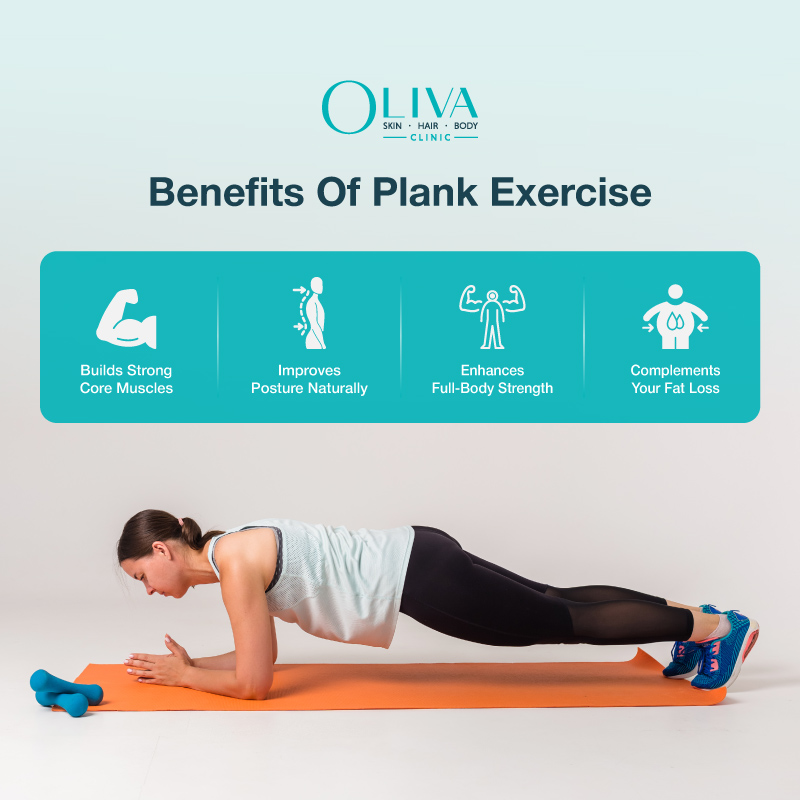
A plank pose is an effective exercise that strengthens your core, in which you hold a push-up position with your forearms and toes on the ground. It focuses on muscle endurance and stability, unlike other exercises that focus on movement. Holding a plank for a few seconds every day strengthens the core muscles, making your daily movements easier, protecting your spine, and improving your balance and posture.
How To Do Plank Exercise: A Step-by-Step Guide?
- Start by lying face down on the mat.
- Place your forearms on the ground with elbows aligned under your shoulders.
- Lift your body, supporting yourself on your forearms and toes.
- Keep your head, back, hips, and legs in a straight line.
- Engage your core, glutes, and thighs.
- Hold the position while breathing normally for 20–60 seconds.
Consistency and proper form are key to enjoying daily plank exercise benefits.
Different Types Of Plank Exercise
- Forearm Plank: This is the classic plank posture, which helps engage the deep core and strengthen your spine. In this variation, your body forms a straight line from head to toes, and you are balanced on your forearms and toes. Your elbows are aligned with your shoulders. It is important to engage your core and glutes, and keep your hips in a straight line.
- High Plank: Similar to the push-up position, but you rest on your palms and toes and lift your body up, so you are slightly inclined. This posture engages your arms, and the core.
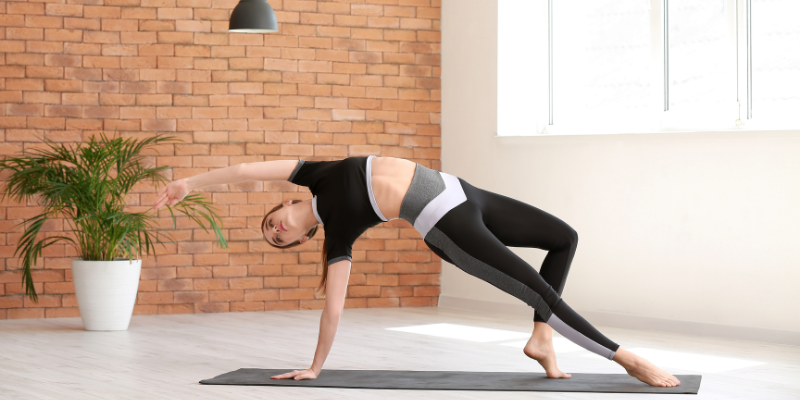
- Side Plank: In this variation, you hold the plank sideways, targeting the obliques, while improving your strength and stability on the sides. You balance on one forearm and the side of one foot, with your hips lifted. All your body parts are aligned sideways. [1]
- Knee Plank: This plank variation is best for beginners and those who have just started strength training. In this modified version, you can rest your knees on the floor while holding your upper body, from the head to the knees in a straight line. Make sure to engage your core in the posture. Once you are comfortable holding the body in this position for 30 seconds to 1 min, you can try the full plank.
- Plank With Leg Lift: This is a slightly advanced variation of the plank, where you are in the classic plank position, but lift one leg and rest on the other. You repeat this with both legs. Make sure you engage your core and keep your back and legs aligned. No tilting.
- Plank with Shoulder Taps: This is a dynamic version of the plank that requires balance and control. You start by getting into a high plank position and tapping your shoulders. Make sure you engage your core and keep minimal hip movement as you lift a hand to tap the opposite shoulder.
- Reverse Plank: This plank variation works on the chain of muscles in the back. Facing upwards, your body forms a straight line (like in the classic plank), while resting on your palms and heels.
What Are the Benefits Of Plank Exercise?
- Builds Strong Core Muscles: Planks need you to engage your abdominal muscles, the obliques, lower back, and pelvic muscles. Doing it every day can help you build a strong core. [2]
- Improves Posture Naturally: Plank position keeps your spine aligned, and with time, you can reduce slouching and the appearance of rounded shoulders. [3]
- Supports Back Health: The position engages your back along with your core, reducing the risk of lower back injuries and pains, and strengthening your back. [3]
- Enahance full body health: While the main focus is your core and back, balancing your body on these two areas pushes your shoulders, arms, glutes, and legs to work in alignment, strengthening the entire body.
- Boosts Balance and Stability: When your core and back become stronger, your body’s balance improves, making daily activities and chores easier to perform. It also increases your body’s ability to engage in challenging physical activities.
- Complements Your Fat Loss: Planks don’t directly help burn calories, but as your core strengthens, your metabolism improves, which supports your fat-loss efforts. [4]
- Adapts To Different Body Needs & Fitness Goals: Fitness experts recommend planks for people of all age groups and fitness levels – from beginners to athletes, as it improves strength, metabolism, and overall well-being.
What Are the Side Effects Of Plank Exercise?
There are no side effects of plank exercise as long as you maintain the form and posture. Bad posture can strain your wrists, cause too much pressure on your lower back, resulting in pain, and may even cause shoulder discomfort. If you are a beginner, make sure there is a professional guiding you. Start small and build slowly.
Who Should Avoid Or Be Careful While Doing Planks?
People with chronic lower back pain, injured shoulders and wrists, and those recovering from spinal surgery, must perform this only under the supervision of certified fitness experts. It needs to be done slowly and with care. If you are pregnant, check with your gynaecologist and fitness expert before doing it.
Takeaway
Plank is a simple yet highly impactful full-body workout that strengthens your core, improves posture, and your overall ability to perform daily activities of varied intensity – from everyday tasks to athletic-level activities. Make sure you include it in your fitness routine, but start under the guidance of a professional fitness trainer. Engaging in the right form and posture is essential for long-term benefits, with your safety guaranteed.
Frequently Asked Questions
No, plank does not reduce belly fat, but it helps strengthen your core muscles. A strong core helps you perform physical activities better. If you want to lose fat in the belly area, you need to increase calorie expenditure, change your lifestyle, and engage in physical activity that works your entire body.
Engaging in planks every day strengthen muscle, core stability, improve form for physical activity, endurance, and your posture.
If you have just started, try to hold for 20-30 seconds. People who have been engaging in physical activity for longer duration hold it for 1-2 mins per set.
Most people drop their hips, stop breathing, put too much stress on their necks, or shoulders are misaligned.
This varies for everyone and depends on where you are in your fitness journey and the workout routine on a particular day. 2-4 sets of 1 min planks can be the ideal number. You can start by holding for 10-15 seconds and gradually increase the time.